


Introduction
If you pay someone to clean your apartment every week, or you've brought in a nanny to help with the kids, here's something almost nobody tells you in Switzerland: you just became an employer.
Not "sort of." Not "informally." Legally — with the same social-insurance registration, payroll, and paperwork obligations that apply to a company hiring its first employee. We built Clino because that gap between what people assume ("I'm just paying someone for a few hours") and what the law actually requires is where good, well-meaning households quietly end up exposed — and where the person they hired ends up with no safety net at all.
The Problem
Switzerland treats domestic work as real employment, because it is real employment. Regularly pay someone for cleaning, childcare, caregiving, or gardening in your own home, and you're required to register as an employer with your cantonal AHV compensation office — the same body that administers pensions and disability insurance — withhold and remit social security contributions, and, depending on hours and income, arrange accident insurance (UVG) and possibly a pension plan (BVG).
This isn't a grey area reserved for "big enough" households. SECO's own guidance on the simplified accounting procedure — the streamlined process built specifically for arrangements "such as those regularly occurring in private households" — caps at CHF 22'680 per employee and CHF 60'480 total payroll before more complex rules kick in. Cantonal compensation offices like SVA Zürich and Ausgleichskasse Basel-Stadt both state plainly, in almost identical language, that anyone employing a cleaner, babysitter, or caregiver must register — "in jedem Fall" (in every case) — above a token CHF 750-per-year pocket-money exemption.
Most households don't find out until something forces the issue: an accident with no insurance behind it, a compensation-office letter asking about back-contributions, or an employee who — reasonably — wants their AHV contributions to actually count toward their own pension someday. And good intentions aren't a substitute for getting it right: when federal labor inspectors checked domestic-work employers in 2023–2024, 6% of them were paying below the legally mandated minimum wage for household work, prompting the Federal Council to raise those minimums again for 2026. Even employers trying to do the right thing are getting the numbers wrong.
The paperwork to do it properly is real: a compliant employment contract, correctly calculated payroll and payslips, registration with the right agency in the right canton — 26 cantons, 26 sets of forms and terminology — plus ongoing annual reporting. It's not something most families have any reason to already know how to do.
The Solution
Clino exists for the moment right after you've found your cleaner, nanny, or caregiver — you already know who you want to hire, you just don't want to become an accidental payroll administrator to do it legally. It turns the employer side of hiring domestic help into a short guided process instead of a stack of cantonal PDFs: answer a few questions about the job and the canton, and Clino generates the compliant contract, calculates payroll, and walks you through AHV registration and the right insurance — in the language you and your employee actually speak.
How Clino Actually Works
Clino describes its own process about as literally as possible: enter details, Clino calculates, done.
- Enter details — wage, hours, canton, and who you're hiring (cleaner, nanny, caregiver). That's the whole input.
- Clino calculates — AHV/IV/EO, ALV, UVG, and the cantonal FAK contribution, using the official 2026 BSV and Suva rates for that specific canton. Average time to get through this step is about four minutes.
- Done — a compliant employment contract, a PDF payslip, and the AHV registration paperwork, regenerated automatically every month after that.
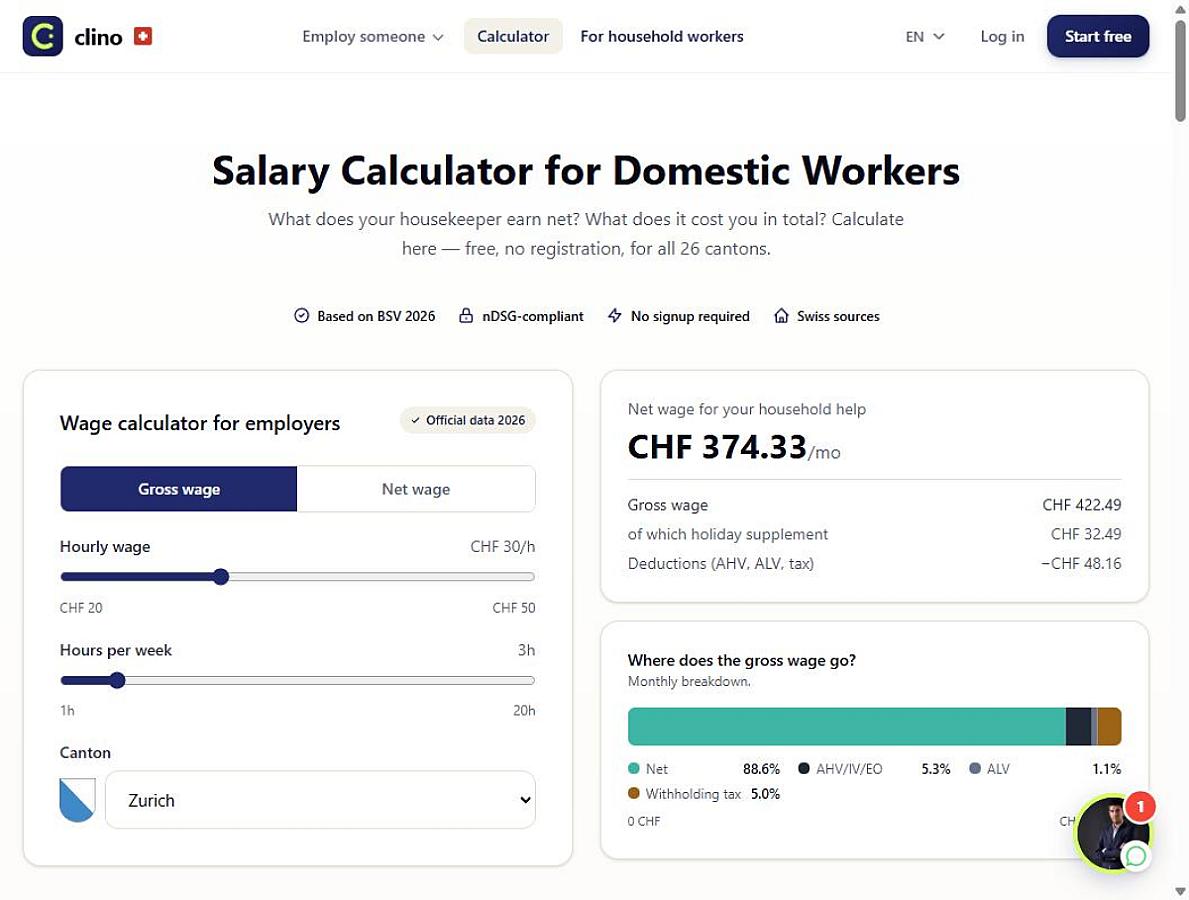
The FAK (family allowance) contribution is the one number that actually changes by canton — everything else in the calculation is federal. Here's the same job, CHF 30/hour for 3 hours a week, priced out in three different cantons:
| Canton | FAK rate | Employee net wage | All-in cost with Clino | All-in cost, DIY with an accountant |
|---|---|---|---|---|
| Zurich | 1.02% | CHF 374.33 | CHF 475.89/mo | CHF 515.99/mo |
| Ticino | 1.60% | CHF 374.33 | CHF 478.32/mo | CHF 518.42/mo |
| Geneva | 2.22% | CHF 374.21 | CHF 481.06/mo | CHF 521.16/mo |
(Numbers straight from Clino's own calculator — worth plugging in your real hours and canton, since FAK alone moves the total by a few francs a month.)
Key Features
- Compliant employment contracts: generated under the Swiss Code of Obligations, tailored to the job (cleaning, childcare, caregiving) and the canton.
- Automatic payroll and payslips: correct deductions calculated and turned into a proper payslip, no spreadsheet required.
- Guided AHV employer registration: canton-specific steps instead of generic advice, covering all 26 cantons.
- Insurance guidance: clarity on accident insurance (UVG) and pension (BVG), including the simplified VAVplus procedure, so you know exactly what applies to your situation.
- A real cost calculator: see the true all-in cost of employing someone before you commit, not just the hourly rate you agreed on.
- Deadline reminders: for the annual wage declaration most households forget about until the compensation office writes to them.
Who's Behind Clino
Clino was built by Salvador Jovells, who moved to Switzerland from Spain in 2017. In his own words, from Clino's about page:
"Nobody works off the books out of bad intentions. The system just makes it too complicated to do it right."
Before Clino, he spent about a decade in digital marketing — mostly making complicated processes simple enough that ordinary people would actually use them. Legally employing domestic help in Switzerland turned out to be one of the most complicated processes he'd run into: the insurance and payroll rules themselves aren't that hard, but they're buried under enough cantonal paperwork that almost nobody without an HR background gets all the way through it. Clino is that same simplification instinct, pointed at one very specific bureaucratic wall.
In the Media
Two data studies from Clino's own research program have been picked up by Swiss press so far:
- watson.ch (18 July 2026) covered Clino's study measuring Swiss household electricity use on the night of the Switzerland–Argentina World Cup match — the country never set an alarm, it just never went to bed.
- tio.ch (11 June 2026) cited Clino's canton-by-canton cost data in a piece asking what legally employing domestic help actually costs in Ticino.
Both came out of the same Press & Studies page — Clino publishes the underlying wage, insurance, and undeclared-work data as its own open dataset rather than only as private research, on the logic that a data journalist finding a real, checkable number is worth more than a press release asking for coverage.
Where This Is Headed
Clino already covers the core employer workflow — contract, payroll, AHV registration — for all 26 Swiss cantons. From here, the two directions are deepening the insurance side (moving from guidance today toward a fuller assisted handoff for accident and pension cover) and continuing the public data-research program that produced the two press citations above. The bet is the same one the product itself is built on: making the right thing easy, and visible, beats asking people to do it out of obligation.
Frequently Asked Questions
What problem does Clino solve?
It solves the legal-employer problem that comes with hiring domestic help in Switzerland — AHV registration, insurance, contracts, and payroll — the parts nobody teaches you and no cantonal website explains in plain language.
Who should use Clino?
Any private household in Switzerland paying someone regularly for cleaning, childcare, elder or disability care, gardening, or similar home-based work, especially if you found that person yourself rather than through a staffing agency.
When is Clino the right choice?
As soon as you've agreed to pay someone for recurring work in your home, even a few hours a week. The employer obligations don't wait until a household feels "big enough" — the CHF 750-per-year pocket-money exemption is the only real cutoff, and it's low.
How is Clino different from alternatives?
Staffing agencies match you with a worker and charge accordingly. Clino assumes you've already found your person and focuses only on making that relationship legally correct — contract, registration, payroll — for a flat CHF 19.90 a month instead of an agency's ongoing cut, with a 30-day free trial to see if it fits.
Conclusion
The uncomfortable truth is that "informal" domestic help in Switzerland was never actually informal — it was just unregistered, and unregistered carries real exposure for both sides: back-payments and fines for the household, no safety net for the employee. Clino doesn't change the rules. It just makes following them take minutes instead of a stack of cantonal forms. If you've already found the person you want to hire, clino.ch is the fastest way to do the rest properly.